


Your first semester of college is approaching, and you have no idea what to expect or what you will need? First of all: Don't panic on the Titanic! With this guide, I want to help you to keep a cool head so you can look forward to the start of your studies with excitement!
My name is Stefanie, and I'm in my sixth semester of the bachelor's program in Journalism and Communication Studies. My degree is almost complete, and I have fond memories of when I first started college. Before and during my studies, there were a few things to keep in mind: from attending the orientation session to coordinating my classes. Since there are so many things to handle at once and it's easy to lose track of everything, tips for starting college would have been ideal for me. But now, I can summarize everything you need to keep in mind to ensure a successful start to your studies.
With this checklist, you'll be ready for the start of the semester
Before we get to the tips, I'll show you what supplies you absolutely need to start college. I've put together a handy checklist for you:
- laptop/tablet and charging cable
- power bank
- cell phone and charging cable
- headphones
- notebook, folder, pens, sticky notes
- calendar
- bag/backpack
- water bottle and snacks
These days, you won't get very far in your studies without a laptop or tablet. Virtually everything happens online. That's why you definitely need a fully funtional laptop or tablet. Also, never forget to bring your charging cable. It's a good idea to pack a power bank just in case you forget your charging cable. These are available not only for cell phones but for tablets and laptops as well.
You probably won't forget it at home: your cell phone is your faithful companion. You can use it to plan your first semester and check when your next lecture is. A charging cable is also important. Headphones are also essential if you want to listen to an online lecture without disturbing those around you.
Of course, your starter kit shouldn't be without all the necessary notebooks, folders, and pens. It's best to organize each lecture in your folder using divider sheets or to use sticky notes so you know exactly where the notes for a new lecture begin. Sticky notes are also a good solution if you want to add a note later but don't have any more space on the page.
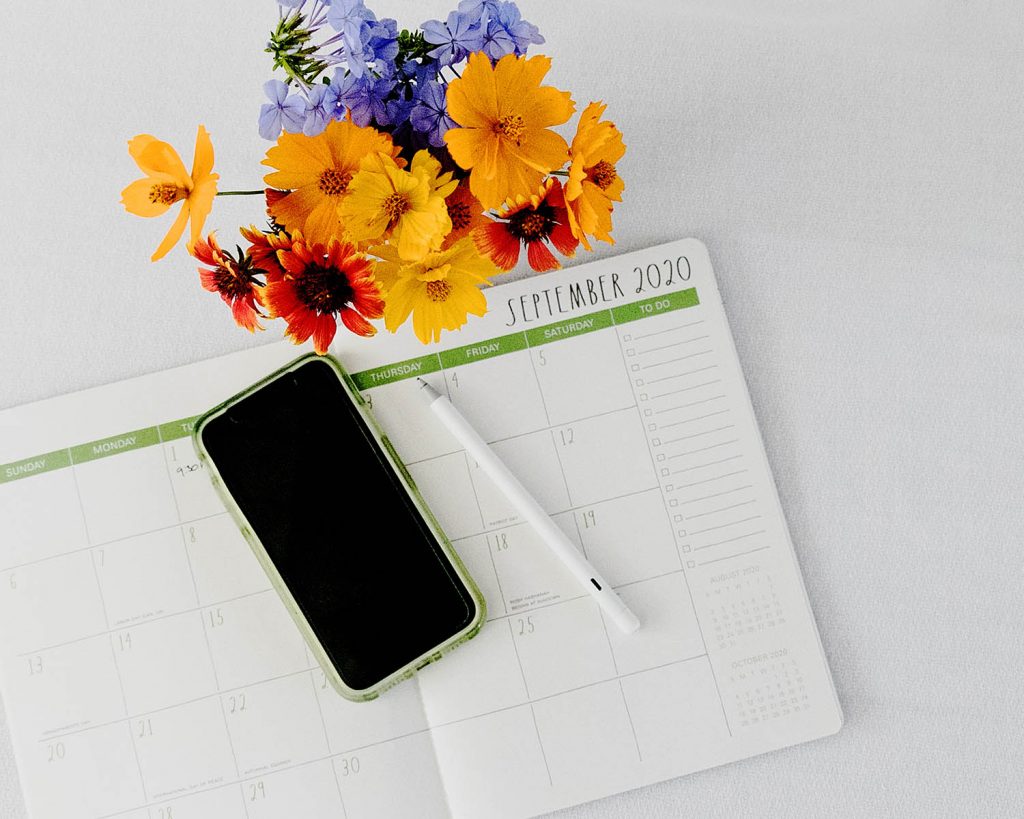
A calendar gives you an overview of your entire academic program. You can use it to jot down all your classes and other appointments. Of course, you can also use your phone's calendar for this. Luckily, there are many more helpful apps for your studies.
To carry everything, you'll need a bag or backpack. Be sure to check that your laptop fits inside before you buy it! Note: if you are going to a library, you'll need a clear bag most of the times! This is to ensure you don't bring any food with you, since eating isn't allowed. My tip: you can often get free clear bags at college fairs. ;)
Outside the library - for example in study areas - you're allowed to eat. So feel free to bring snacks for your breaks, because your brain needs fuel and a break from all that studying. I recommend fruit, nuts, granola bars, or a sandwich.
10 tips for a successful start to your studies
Have you already sent the necessary documents to your university, passed the entrance exam, and been admitted to your program? Have you also found a place in a student dorm and bought a semester pass for public transportation? Congrats! Then here are some tips to help you get started:
(1) Log into your university's online portal
Have you already paid the tuition for your first semester? You usually won't be admitted without paying it, but it doesn't hurt to check. Take a look at the curriculum - your course schedule - and print out your study plan. The study plan lists all the modules you need to complete and helps you stay on track so you don't forget anything. It's been a big help to me because I can simply check off the modules I've passed. All other important information is also explained in great detail on the relevant websites for your program.
(2) Search online for the student organization for your degree program
In my program, the student organization is called "IG Publizistik", and I'm glad it exists. You can always call these organizations, send them an email, or stop by in person. Whether you have questions about your first semester or exams, the student organizations you have chosen are always happy to help. If you have more general questions - for example about financial aid - you can contact larger student organizations. At the University of Vienna, the ÖH Wien is responsible for this.
(3) Check the date of the orientation session for your degree program
The orientation session is an important event that you shouldn’t miss! On this day, you’ll usually gather in your university’s largest lecture hall to hear the instructor explain what you need to keep in mind during your first semester. They’ll discuss how to register for courses, what ECTS credits are, and you’ll have the chance to ask any additional questions. So, as a rule, you don’t need to register for any courses until this session takes place. Often, other student organizations will also introduce themselves there, such as so-called “buddy projects,” which you can join to receive support throughout your studies.
(4) Look for the required reading materials
Textbooks are a must during college. But you don’t always have to buy all your books new. You can often find book exchanges online, or you can check your program’s Facebook groups, where used textbooks are sold. That’s how it was for me: I bought textbooks from other students and, once I no longer needed them, sold them again on Facebook. If you buy a textbook for the same price and then sell it, you haven’t actually spent any money on it. Cool, right?
(5) Find out about financial aid for your studies
As a student, you are often eligible for government financial aid to help you pay for your studies. Your parents are generally eligible for family allowance while you are in school, regardless of their income. In addition, you can also apply for a student grant if you meet the financial eligibility criteria. This depends on several factors: income, marital status, family size, etc. It’s worth finding out whether you might be eligible for financial aid.

(6) Review the curriculum and plan your first semester
The STEOP – the study entry and orientation phase – should be manageable within one semester in any degree programme. However, if your programme is more demanding, you shouldn't force it. In that case, it's perfectly fine to take longer. As a general guideline: if you want to finish in six semesters, you need to complete 30 ECTS credits per semester. This really does depend on your specific programme. In my case (journalism/communication studies), the STEOP wasn't particularly difficult, which meant I could attend additional courses alongside it. You can plan your future semesters the same way: before each new semester begins, mark the courses you intend to take.
(7) Note all the dates of the first lectures in your calender
This is also a very important point. It's easy to lose track of things when you have multiple lectures on the go. That's why it's best to enter all your appointments before the semester starts – including the exact time, lecturer, and lecture hall number – into either a physical planner or your phone's calendar. This comes down to personal preference. I, for example, use a physical planner and always write down every appointment through to the end of the semester. That said, you obviously shouldn't forget to bring it to university with you. Since you're unlikely to forget your phone, a digital calendar might simply be easier for some people.
(8) Attend the classes and participate actively
There is nothing worse than realising at the end of the semester: oh, maybe I should have kept up with the studying after all. Exam period is usually at the end of January, and if you only start looking more closely at the course material then – with multiple exams to sit – it's already too late. So don't just take notes during lectures; sit down at home afterwards and review the material as well. This means reading everything through again, highlighting the important points, and writing down any open questions. Those questions should either be clarified directly with the lecturer or a teaching assistant, or by asking fellow students. This way, you won't run the risk of having to cram everything in at the very end of the semester.
(9) Download the Studo App
The Studo App accompanied me throughout my entire degree. The app is truly great, as it brings together everything related to your studies in one place. From your courses and a clear, well-organised calendar to a built-in chat function – it has it all. But that's not all: you can also browse job listings, read news, check the menus of university canteens, receive vouchers, and access your university emails and grades. The possibilities this app offers are virtually endless, and it gives you a very solid overview of everything you need.
(10) Look for Facebook and WhatsApp groups related to your program
Facebook and WhatsApp groups also proved to be very helpful for me during my studies. All kinds of important information related to your degree gets shared in these groups. I particularly found Facebook groups useful. Through them, I could look for literature and gain access to lecture notes whenever I had missed a class. Before exams, I also liked to check whether anyone had posted a good summary of the exam material. Of course, summaries written by others are no substitute for actually attending lectures – but they are still incredibly helpful.

Conclusion on starting your studies
All of these tips helped me get through my first semester successfully. Structure is key when it comes to studying, and I hope my tips have been useful in giving you a good overview of what to expect at the start of your degree.
But don't forget: while structure is important, you shouldn't be too much of a perfectionist. Sometimes things don't go according to plan. If you fail an important exam, for example, don't panic straight away. You don't have to achieve everything in the shortest possible time. Having a good balance alongside your studies is just as important, so that your mind stays fresh and ready to take in new information. Because there is one thing you will certainly learn during your studies: you need to be flexible. If one approach doesn't work, you try another. There are always multiple paths, and many of them lead to the same destination.
P.S.: Find out how to create a study plan and how to overcome exam anxiety in our other articles.
With that in mind: best of luck as you begin your studies!